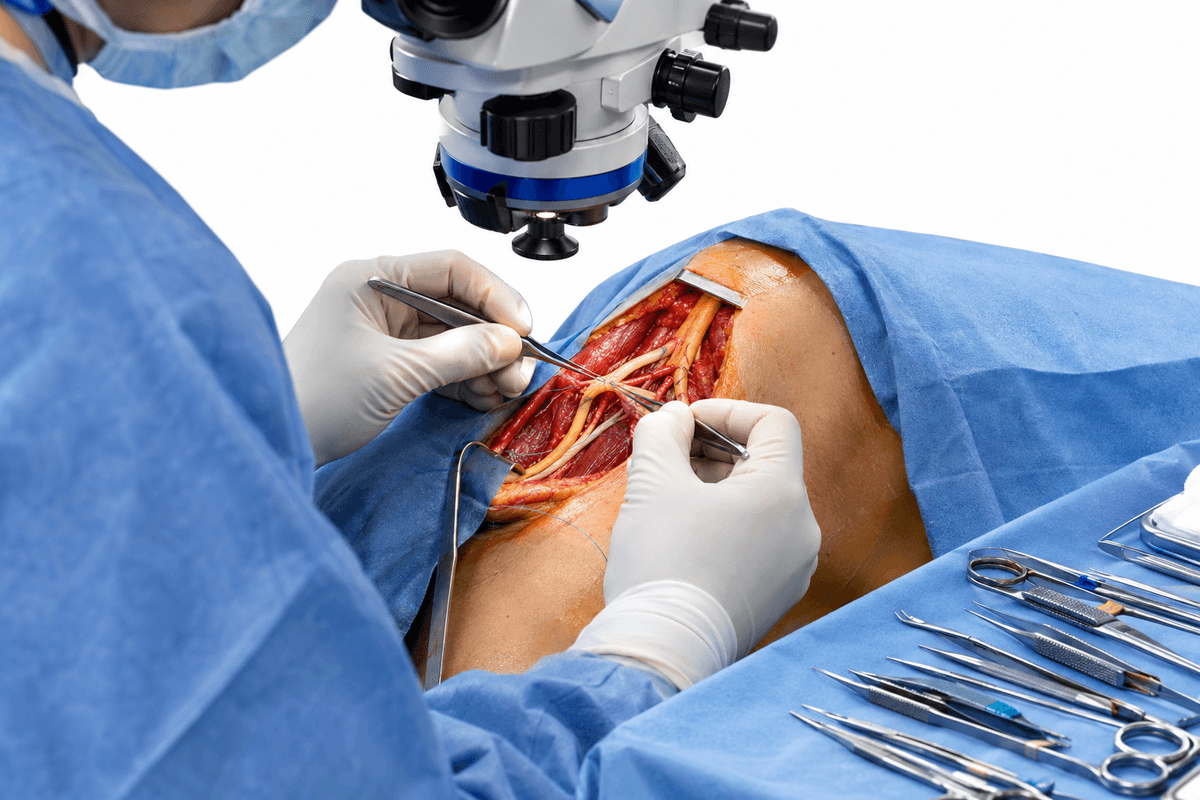
Performed by Dr. Surya Sri Krishna Gour
Nerve transfer surgery is a procedure that restores function after brachial plexus injuries by redirecting healthy nerves to damaged ones. When nerves in the shoulder and arm network are severely injured, Dr Surya Sri Krishna Gour may use this technique to help regain movement and sensation. The procedure involves taking a working nerve from a less critical muscle and connecting it to a more important paralyzed muscle.
We believe in honest, upfront disclosure so you can make an informed decision.
A step-by-step look at what happens during this procedure.
The surgeon uses a microscope to locate and identify healthy donor nerves that can be spared and injured recipient nerves that need reconnection.
A less critical functioning nerve is carefully divided, ensuring enough length remains to reach the paralyzed muscle's nerve.
The damaged nerve ending near the paralyzed muscle is prepared by trimming away scar tissue to expose healthy nerve tissue.
The donor nerve is surgically connected to the recipient nerve using fine sutures under high magnification, creating a path for nerve fibers to grow.
The incisions are closed and the arm is positioned to protect the nerve repair while healing begins.
A structured, patient-first approach from first consultation to full recovery.
Dr Surya Sri Krishna Gour reviews nerve conduction studies, MRI scans, and physical examination findings to map which nerves are damaged and which donor nerves are available.
Using operating microscopes and specialized instruments, the procedure is performed with precision to ensure accurate nerve alignment and minimal trauma to surrounding tissues.
The choice of donor and recipient nerves is tailored to each person's injury pattern, functional goals, and the time elapsed since injury.
Post-surgery care includes coordinating with physiotherapy teams to guide nerve regeneration and muscle re-education over the months of recovery.
What to expect at each stage of your recovery journey.
The arm is kept in a protective position or splint to avoid tension on the nerve repair. Wound care and pain management are the focus during the first few weeks.
Over several months, nerves regrow at roughly one millimeter per day. Gentle range-of-motion exercises prevent joint stiffness while waiting for nerve signals to reach muscles. Individual timelines vary widely.
Once nerve signals arrive, intensive physiotherapy helps retrain muscles to respond to new nerve pathways. Strength and coordination improve gradually, and progress depends on individual factors.
The procedure aims to restore key functions such as elbow bending, shoulder movement, or hand grasp, depending on which nerves are transferred. Complete return to normal strength is uncommon.
Because a working nerve is redirected, there may be permanent loss of the donor muscle's original function. The goal is to gain a more important movement while accepting a less critical loss.
Success depends heavily on how soon the procedure is done after injury and whether muscles have become too weak or scarred. Delays beyond 12-18 months reduce the likelihood of meaningful recovery.
While motor function is the primary goal, sensory recovery is often incomplete or absent. Numbness or altered sensation in the affected areas may persist.
The right choice depends on your diagnosis, risks and circumstances — discussed with you at your consultation.
If the nerve ends are close together and healthy, they can be stitched directly without needing a transfer. This is preferred when possible but depends on the injury location and severity.
A piece of nerve from another part of the body bridges the gap in a damaged nerve. This may be considered when the nerve gap is too wide for direct repair but the original nerve pathway is still viable.
Instead of rewiring nerves, working muscles and tendons are repositioned to take over the job of paralyzed ones. This option may be chosen when nerve recovery is unlikely or when muscles have deteriorated too much.
Let's clear up some of the most common myths about nerve transfers for brachial plexus injuries.
Get a personalised assessment from an experienced specialist. Understand your options, ask your questions, and decide with confidence.